
What Hair Oil Is and How It Is Used
Everyday Hair Care Guide is an independent English information guide, and this overview explains hair oil by its practical role in a routine. The same product category can mean a pre-wash treatment or a leave-on finishing product, so the label and intended use matter. Application also differs by location: the scalp is skin, while lengths and ends are hair fibers with different cosmetic needs. Knowing that distinction helps you interpret directions and decide whether a product should be washed out.
Oil in hair care
Hair oil is a product made with oils or oil-like ingredients that you use on the scalp, hair fibers, or both, according to its directions. It may be designed to remain in the hair as a leave-on product or to sit for a limited period before shampooing. The package should identify its intended area and whether it needs rinsing; a finishing oil and a pre-wash oil are not automatically interchangeable.
In a routine, oil mainly serves a cosmetic conditioning or finishing role. On the lengths, a suitable formula can make the surface feel smoother, add shine, and help reduce the rough feel caused by friction between strands. A scalp product is intended for contact with the skin, whereas a product labeled for lengths may be too rich or unsuitable for use at the roots. These effects describe appearance and feel, not a change to the hair’s underlying structure.
When you consider how to choose hair oil, use its stated purpose rather than assuming that every oil has the same effect. Hair oil does not, by itself, establish a medical treatment or guarantee hair growth, repair, or a lasting result. It can complement cleansing and styling, but it cannot replace shampoo or permanently mend a split hair fiber. Check whether the directions call for rinsing, because that instruction determines how the product fits into your wash routine.
Scalp versus lengths
Scalp application means placing a product on the skin between the roots; length application means coating some or all of the hair shaft, particularly the mid-lengths and ends. The intended use determines the target: a scalp-labeled oil is formulated for skin contact, while a length product is meant to condition or finish the fibers. Hair near the roots is not the same surface as the scalp, even when the two are only millimeters apart.
Scalp-directed products are generally applied in narrow partings so the oil reaches the skin rather than sitting only on top of the hair. Their directions may specify a brief contact period or a longer pre-wash interval, followed by shampoo to remove the residue. Follow the stated timing instead of assuming that overnight contact is necessary; labels differ by formula, and some scalp oils are designed to be rinsed out at the next wash.
For the lengths or ends, placement follows the portion of the hair that feels dry, rough, or needs a polished finish. A leave-on formula stays on the fibers between washes, so its directions usually focus on a small amount and keeping it away from the roots. A pre-wash length treatment, by contrast, is removed during shampooing after its directed contact time. These distinctions affect both how much hair receives the product and whether residue remains after styling.
Use the label to resolve products that mention both scalp and lengths: it may give separate amounts or timing for each area. If the package names only one target, keep application to that zone rather than extending the use by assumption. This placement-based approach makes it clear whether the product is intended for skin contact, conditioning along the shaft, or a temporary finish.
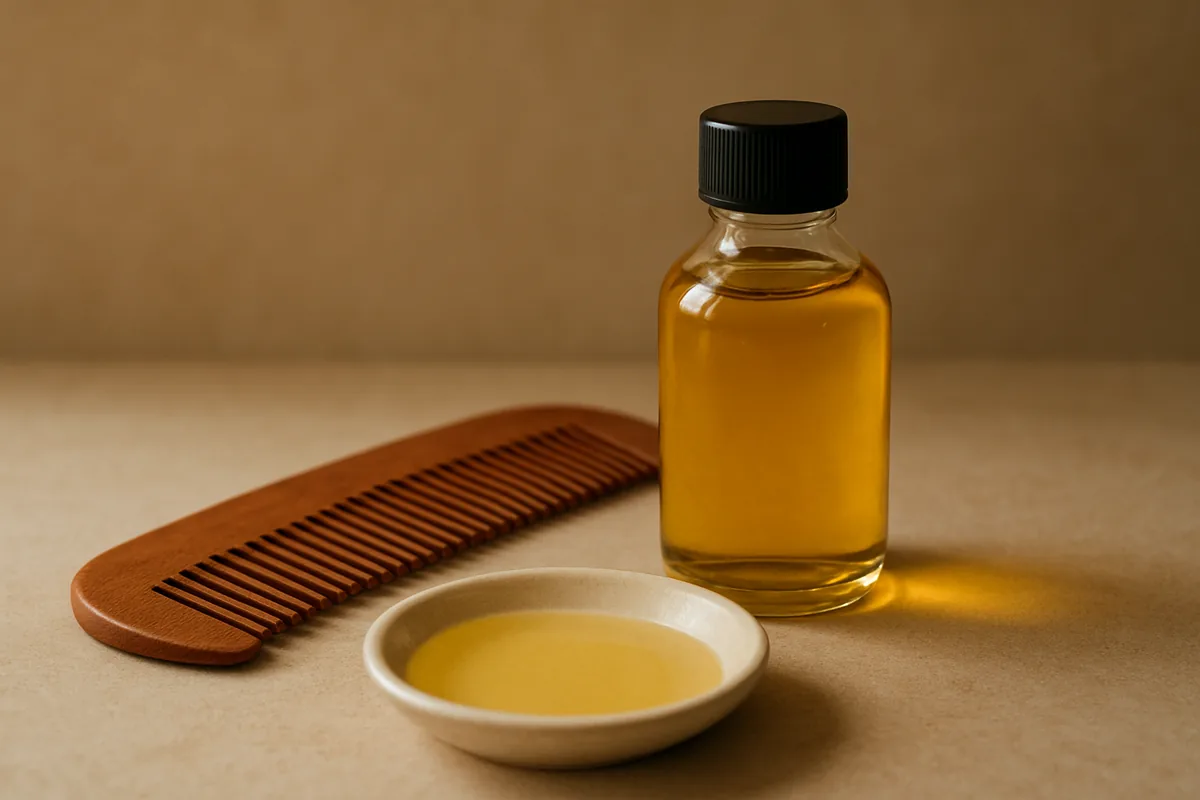
Common Types of Hair Oil
Hair oils differ not only by their source but also by how the formula is built. A bottle may contain one plant-derived oil, a blend of botanical oils, or a finishing formula that combines oils with other conditioning ingredients. These categories can vary in thickness, spread, and the kind of finish they leave on the hair. Reading the ingredient list alongside the product description helps clarify what a formula is designed to do.
Plant-derived oils
Plant-derived oils are obtained from botanical materials such as seeds, nuts, or fruit, and may be sold as a single oil or combined with other plant oils. Argan, coconut, and jojoba are familiar examples, but their names alone do not determine how a finished formula will feel: concentration, processing, and the other ingredients in the bottle also matter.
Compared with blended finishing oils, a single plant oil has a simpler ingredient profile, while a botanical blend combines oils to create a different balance of feel and spread. Neither category has one standard texture; the descriptions below are broad distinctions, not guarantees for every product.
| Category | General use | Texture or spread | Limitations |
|---|---|---|---|
| Single plant-derived oil | A straightforward oil option for conditioning or adding surface sheen. | Often has a distinct, oil-like feel; spread varies with the particular oil and its refinement. | May feel heavy or leave residue when the amount or formula does not suit the hair. |
| Blend of plant-derived oils | Combines botanical oils in one formula for conditioning and surface smoothness. | Can spread differently from a single oil; the blend and proportions shape its feel. | Ingredient names do not reveal the exact performance or relative amount of each oil. |
| Blended finishing oil | Designed as a hair-finish formula, often combining oils with other conditioning ingredients. | May feel lighter or spread more readily than a straight plant oil, depending on the formula. | Ingredients and finish vary, so the category alone does not predict how it will feel. |
Plant-derived describes the source of an oil, not a fixed level of richness or a guaranteed result. Check the full formula and product directions rather than choosing by a botanical name alone.
Blended finishing oils
Blended finishing oils are formulated specifically for use on hair, rather than being defined only by the source of their oil ingredients. A formula may combine one or more plant oils with conditioning or smoothing ingredients; some use silicones, while others are silicone-free. The ingredient list is the best way to identify which approach a particular product takes.
Compared with a single plant-derived oil, a finishing blend is often designed to distribute readily through the hair and leave a more controlled surface feel. Its texture may be lighter, more fluid, or less oily to the touch, but this is not universal: formulas differ, and some blends still feel rich. Plant oils are the main defining ingredients in a botanical blend, whereas a finishing product may rely on a wider mix of components to shape spread, slip, and finish.
The main practical limitation is variability. Two products called hair oil can have very different ingredient lists and finishes, so the label does not tell you whether a formula will feel weightless, glossy, or substantial. A blend can also make it harder to tell which ingredient accounts for a particular texture or result. Descriptions such as “smoothing” or “finishing” indicate the intended role, not a uniform formula or guaranteed effect.
When comparing products, look at the ingredient list and the product’s stated directions, then consider whether its described finish matches your styling goal. A finishing blend offers a purpose-built alternative to a straight botanical oil, but its suitability depends on the specific formulation rather than the category name.
Choosing an Oil by Hair Texture
Choosing hair oil starts with more than whether your hair is straight, wavy, or coily. Strand thickness and overall density affect how readily a formula spreads and how much weight it adds to the finished look. Your preferred finish matters too: a soft sheen, defined texture, or a smoother surface may call for different product weights. Treat texture labels as a starting point, then judge the result on your own hair.
Fine and straight hair
Fine strands can look weighed down by a rich formula even when the hair is dense; low-density hair may show separation or a slick finish sooner. Consider strand thickness and density separately, then match product weight to the amount of visible coverage you want.
For fine hair, lighter formulas are often easier to distribute without flattening movement. These conditional checks can help you choose:
- If individual strands feel delicate and your hair is low-density, a lightweight formula may leave more lift than a dense, coating product.
- If fine strands are numerous, moderate product weight may spread across the larger volume without making every section appear slick or separated.
- If your straight hair is shoulder-length or longer, a light finish may preserve swing, while a heavier coating can make the ends appear stringy.
- If you want shine without a visibly wet look, favor a formula that leaves a subtle surface sheen rather than a thick, glossy film.
- If your main concern is flyaways, a slightly richer finish may smooth the outer layer, but can reduce root volume on fine hair.
- If your hair is short and fine, product weight is especially visible because there is less length to disperse it across.
- If fine strands are also high-density, you may tolerate more weight than someone with sparse hair, though the finish still depends on formula and styling.
Use the appearance of your hair after styling as the test: if strands clump or lose movement, choose a lighter weight or a less glossy finish next time. A label such as hair oil for fine hair can guide your search, but it cannot account for density, length, or your preferred look.
Thick, wavy, and coily hair
Thicker strands and greater density can make a richer formula easier to distribute without an immediate slick appearance, but neither guarantees that a heavy finish will suit you. Wavy, curly, and coily patterns also create bends and coils that affect how evenly product moves across the hair. For hair oil for curly hair, consider strand thickness, density, length, and the finish you want rather than relying on curl pattern alone.
If your hair is thick and shoulder-length, a medium-weight formula may offer visible sheen while preserving movement. For long, dense waves or coils, a richer product may spread over more hair and leave a smoother, more defined finish. If your strands are coarse but your hair is low-density, however, a lighter product may be less likely to make the overall shape look flat.
Placement can change the visual result. If you want to emphasize definition through the lengths, a formula with enough weight to coat the strands may suit your styling goal; if you prefer airy volume, a lighter finish can keep waves or coils from appearing overly compact. On shorter cuts, even thick hair has less length over which to distribute product, so a heavy coating may be more apparent than it would be on long hair.
Texture categories are useful comparisons, not reliable predictions: two people with similar curl patterns can respond differently because strand diameter, density, length, and styling preferences vary. If a formula leaves your hair coated or reduces the shape you want, try a lighter weight; if the finish looks uneven across dense lengths, a more substantial formula may spread more consistently.
Applying Hair Oil
The way you apply hair oil depends on whether it is going on before a wash or onto clean hair for styling. Dampness affects how readily oil spreads, while sectioning helps you place it where you intend. Work in stages and begin with a small amount, then check how the hair looks and feels before adding more. The two routines below cover placement, distribution, contact time, and wash-out. Use the method that fits your next wash or styling step.
Before washing
A pre-wash routine gives oil time to sit on the hair before shampooing. Start on dry hair for a more concentrated application, or use slightly damp hair when you want it to spread more easily.
- Detangle first with fingers or a wide-tooth comb, working from the ends upward; this makes it easier to separate sections without pulling oil across the scalp.
- Choose dry or slightly damp hair according to how you want to distribute the oil; avoid soaking wet strands, which can make placement harder to judge.
- Divide the hair into manageable sections, using clips if needed, so you can reach the back and underside rather than coating only the surface.
- Begin with a small amount in your palms, rub your hands together, and smooth it onto the chosen area instead of pouring oil directly onto the hair.
- For a lengths-focused application, work from around mid-length to the ends; move through one section at a time and keep the distribution even.
- Use your fingertips to spread oil across the ends, where strands may feel rougher, then lightly pass your hands over each section to blend any visible patches.
- Leave the oil in place for about 20 to 30 minutes as a practical pre-wash interval, then shampoo thoroughly; repeat washing only if the hair still feels coated.
Check the hair before shampooing: it should have a light, even coating rather than isolated slick areas. After rinsing, use your usual conditioning step if needed.
After washing or styling
On clean hair, oil can be applied while strands are damp or after they are dry and styled. Damp hair is often easier to smooth through evenly, while dry application lets you see the finish as you work.
- After washing, gently towel-blot first so the hair is damp rather than dripping; excess water can make oil slide around and obscure how much has been applied.
- Start with a small amount in your palms and spread it between both hands, creating a thin film before touching the hair.
- Gather a section loosely and glide your hands over the mid-lengths toward the ends, keeping the application focused rather than pressing oil into the roots.
- Work across the remaining sections with the same light hand motion, then use your fingers or a comb to help distribute oil through any areas that feel uneven.
- For dry, styled hair, smooth oil over the surface and ends in short passes; pause between passes so you can see whether the finish is already smooth.
- Check the hair in natural or bright indoor light for shine, separation, and movement; feel the ends as well to judge whether they remain dry or feel coated.
- If the finish still looks or feels dry, rub a little more oil between your palms and apply it to the ends first, reassessing before making another adjustment.
Let damp hair finish drying before judging its final appearance, since wet strands can look darker and more defined. For styled hair, assess the result once your hands are no longer smoothing it.
Common Oil-Use Mistakes
A hair oil can leave a smooth finish when it is applied evenly, but excess product may make strands look flat, separated, or greasy. The amount that works on dense, coarse hair can overwhelm fine strands, especially when the formula feels rich. Placement matters too: oil on the scalp has a different purpose from a small amount worked through the lengths. Adjusting the dose and target area can often correct the finish without changing the product.
Using too much
Too much oil often shows up as strands that clump into narrow sections, look wet long after application, or lose their lift at the roots. A heavy coating can also make the ends feel tacky and attract lint, while uneven distribution leaves some sections glossy and others rough. Check the hair in daylight after it has settled for a few minutes; a slick surface or piecey appearance usually means the dose was larger than the lengths could absorb.
Product weight needs to match the hair’s density and strand thickness. Fine hair can look limp after even a small excess of a rich oil, whereas thick or tightly curled hair may spread the same amount across more strands without looking coated. For hair oil for fine hair, start with one drop, warm it between the palms, and add only if the ends still feel dry. Medium or dense hair may tolerate two or three drops, but these are starting points rather than fixed measures.
Reduce the dose before replacing the formula: use half as much at the next application, then assess the finish once the hair is dry. For more even coverage, smooth oil between both palms and lightly press them over the mid-lengths and ends instead of depositing it in one spot. If one section remains greasy, use clean hands to redistribute the residue onto nearby dry ends; avoid adding more oil to compensate for a patch that was missed.
Applying to the wrong area
Oil placed at the roots can flatten a style, separate strands, and make freshly washed hair look unwashed, particularly when the hair is fine or the scalp produces oil readily. By contrast, oil intended to polish the lengths may leave the scalp untouched; applying it only to the part line does not smooth dry ends. Decide whether the goal is scalp care or a finished look before dispensing the product, because each calls for a different target area.
For a length-focused finish, keep the first application below the ears and concentrate on the last few inches, where friction and dryness are often most noticeable. Rub a small amount between the palms, then glide over the surface or gently scrunch it into the ends of curls; avoid rubbing the hairline or crown. If the top looks oily but the ends remain rough, use less near the roots and shift the product downward rather than increasing the total amount.
When the intended use is scalp care, part the hair into narrow lines and place a few drops directly on the scalp rather than coating the hair above it. Massage gently with fingertips so the product reaches the skin instead of sitting on the strands. A pre-wash scalp application can be rinsed out during the next shampoo, while a finishing application belongs on the lengths and is generally left in place. If oil has landed in the wrong area, blot excess with a clean towel or wash it out rather than layering more product over it.
Hair Oil Compared With Hair Serum
Hair oils and hair serums can both add slip and improve the look of hair, but they are not fixed formula categories. An oil is generally built around oils or other lipid-rich ingredients, while a serum may use silicones, water-based ingredients, oils, or a blend. Their feel, spread, and intended placement depend on the specific formula, not just the name on the bottle. Comparing the product’s texture and stated purpose helps match it to scalp, lengths, styling, or finishing needs.
Texture and purpose
Hair oil usually has a liquid, lipid-rich feel: it may be a single plant oil or a blend that spreads with finger-combing across strands. Its role can range from softening lengths to adding gloss, and the finish may feel light or substantial depending on the formula and the amount applied. A product labeled as an oil does not necessarily contain only one oil; ingredients such as fragrance or lightweight emollients can change its slip and finish.
Hair serum describes a broader kind of finishing product rather than one fixed ingredient base. Some serums rely on silicones such as dimethicone to create smooth slip and reduce the feel of roughness; others are water-based or include oils alongside conditioning agents. A serum may feel slick and spread thinly, or creamy and more substantial. Its purpose often centers on a cosmetic result such as shine, a smoother surface, or easier styling, rather than providing an oil-dominant coating.
In use, either product can be distributed through lengths, but their spread and after-feel can differ: an oil may leave a more noticeable, emollient finish, while a silicone-rich serum can feel slippery with less of an oily residue. These are common tendencies, not guarantees. Two products with the same label can behave differently because their ingredient lists, concentrations, and directions vary; names alone do not establish equivalent performance or ingredients.
Choosing between them
Start with placement rather than the product name. For scalp use, compare the label’s stated purpose and directions: an oil formulated for scalp application and a serum intended for the scalp are not automatically interchangeable. Some serums are designed only for hair lengths, while some oils are marketed for scalp care. A product’s texture also matters if you want to avoid a coated feel near the roots.
For lengths that feel rough or look dull, compare the finish you want. An oil may suit a preference for a more emollient, conditioned feel, while a serum may be a better fit when the goal is surface slip or a polished finish. Neither category guarantees a particular result, so check whether the product is described for dry, damp, or styled hair and follow its directions. Styling needs can also guide the choice: a serum designed for smoothing may work differently from an oil intended to add softness.
For finishing, consider how much visible gloss and residue you want, and whether the product is meant to be layered with other styling products. A fine, slippery serum may sit differently from a richer oil, but formulas vary enough that a small trial on one section of hair can reveal the actual feel. The comparison is conditional: choose by scalp versus lengths, desired styling effect, and preferred finish rather than assuming every oil or serum performs alike.